ArtHitParade
ArtHitParade on X
  • Home
    • Contact
  • Calendar
  • Top 10
    • Origin
    • From 600 BCE to CE
    • Years 1 to 1000
    • Years 1000 to 1400
    • 15th Century >
      • Years 1400-1429
      • Years 1430-1459
      • Years 1460-1479
      • Years 1480-1499
    • 16th Century >
      • Years 1500-1519
      • Decade 1520-1529
      • Decade 1530-1539
      • Years 1540-1569
      • Years 1570-1599
    • 17th Century >
      • Decade 1600-1609
      • Decade 1610-1619
      • Decade 1620-1629
      • Decade 1630-1639
      • Decade 1640-1649
      • Decade 1650-1659
      • Years 1660-1679
      • Years 1680-1699
    • 18th Century >
      • Decade 1700-1709
      • Decade 1710-1719
      • Decade 1720-1729
      • Decade 1730-1739
      • Decade 1740-1749
      • Decade 1750-1759
      • Decade 1760-1769
      • Decade 1770-1779 >
        • 1776
      • Decade 1780-1789 >
        • 1787
      • Decade 1790-1799 >
        • 1792
    • 19th Century >
      • Decade 1800-1809
      • Decade 1810-1819
      • Decade 1820-1829
      • Decade 1830-1839
      • Decade 1840-1849
      • Decade 1850-1859
      • Decade 1860-1869
      • Decade 1870-1879 >
        • 1877
        • 1878
        • 1879
      • Decade 1880-1889 >
        • 1880
        • 1881
        • 1882
        • 1883
        • 1884
        • 1885
        • 1886
        • 1887
        • 1888
        • 1889
      • Decade 1890-1899 >
        • 1890
        • 1891
        • 1892
        • 1893
        • 1894
        • 1895
        • 1896
        • 1897 1898 >
          • 1897
        • 1899 1900 >
          • 1899
    • 20th Century >
      • Decade 1900-1909 >
        • 1901
        • 1902
        • 1903
        • 1904
        • 1905
        • 1906
        • 1907
        • 1908
        • 1909
      • Decade 1910-1919 >
        • 1910
        • 1911
        • 1912
        • 1913
        • 1914
        • 1915
        • 1916
        • 1917
        • 1918
        • 1919
      • Decade 1920-1929 >
        • 1920
        • 1921
        • 1922
        • 1923
        • 1924
        • 1925
        • 1926
        • 1927
        • 1928
        • 1929
      • Decade 1930-1939 >
        • 1930
        • 1931
        • 1932
        • 1933
        • 1934
        • 1935
        • 1936
        • 1937
        • 1938
        • 1939
      • Decade 1940-1949 >
        • 1940
        • 1941
        • 1942
        • 1943
        • 1944
        • 1945
        • 1946
        • 1947
        • 1948
        • 1949
      • Decade 1950-1959 >
        • 1950
        • 1951
        • 1952
        • 1953
        • 1954
        • 1955
        • 1956
        • 1957
        • 1958
        • 1959
      • Decade 1960-1969 >
        • 1960
        • 1961
        • 1962
        • 1963
        • 1964
        • 1965
        • 1966
        • 1967
        • 1968
        • 1969
      • Decade 1970-1979 >
        • 1970
        • 1971
        • 1972
        • 1973
        • 1974
        • 1975
        • 1976
        • 1977
        • 1978
        • 1979
      • Decade 1980-1989 >
        • 1980
        • 1981
        • 1982
        • 1983
        • 1984
        • 1985
        • 1986
        • 1987
        • 1988
        • 1989
      • Decade 1990-1999 >
        • 1990
        • 1991
        • 1992
        • 1993
        • 1994
        • 1995
        • 1996
        • 1997
        • 1998
        • 1999
    • 21st Century >
      • Decade 2000-2009 >
        • 2000
        • 2001
        • 2002
        • 2003
        • 2004
        • 2005
        • 2006
        • 2007
        • 2008
        • 2009
      • Decade 2010-2019 >
        • 2010
        • 2011
        • 2012
        • 2013
        • 2014
        • 2015
        • 2016
        • 2017
        • 2018
        • 2019
      • 2020 to now >
        • 2020
        • 2021
        • 2022
        • 2023 to now >
          • 2024
  • Ancient Painting
    • Flemish Art >
      • Pieter II Brueghel
      • Jan Brueghel
    • Rubens
    • Rembrandt
    • Early Still Life
    • Oil on Copper
  • 18th Century Painting
  • Ancient Drawing
  • Art on Paper
  • Sculpture
    • Bust
    • Ancient Sculpture >
      • Roman Sculpture
    • Italian Sculpture
    • French Sculpture >
      • Rodin
    • Sculpture by Painters
  • Women Artists
    • Ancient Art by Women
    • O'Keeffe
    • Lempicka
    • Martin
    • Mitchell
    • Claude Lalanne
    • Yayoi Kusama
    • Brown
  • Furniture
    • Chairs and Seats
    • Colonial Furniture
    • Ancient French Furniture
    • Modern Furniture >
      • Art Deco
      • Modern Tables
  • Prints
    • Ancient Prints >
      • Prints by Rembrandt
    • Modern Prints
  • Photo
    • Old Photos >
      • Travel Photos
      • Early French Photo
    • Photos 1900s 1910s
    • Photos 1920s 1930s
    • Arbus
    • Photos 1970s 1980s
    • Sherman
    • Gursky
  • The Man
  • The Woman
  • Children
  • Man and Woman
  • Groups
  • Self Portrait
    • Self Portrait 2nd page
  • Nude
  • Abstract Art - 2nd page
  • Landscape
  • Venice
  • Paris
  • Flowers
    • Bouquet
  • Animals
    • Bird
    • Cats and Lions
    • Horse
  • Tabletop
  • Music and Dance in Art
    • Music in Old Painting
  • Sport in Art
  • Orientalism
    • Orientalism 1830-1900
  • France
    • French Painting before 1860
    • Pissarro
    • Manet
    • Degas
    • Cézanne
    • Monet >
      • Monet before 1879
      • Monet 1879-1887
      • Series by Monet
      • London and Venice
      • Bassin aux Nymphéas
    • Renoir
    • Caillebotte
    • Gauguin
    • Seurat
    • Signac
    • Lautrec
    • Matisse
    • Léger
    • Klein
    • Lalanne
    • Post War French Art
  • Italy
    • Canaletto
    • Modigliani
    • Fontana
    • Mappa by Boetti
  • Swiss Painting
  • Giacometti
    • Giacometti 1947-53
    • Femme Debout
  • Bacon
    • Bacon before 1963
    • Bacon 1963-70
    • Later Bacons
    • Head Triptych
  • UK - 2nd page
    • Ancient England
    • George III
    • British Royals
    • Turner >
      • Watercolor by Turner
    • Freud >
      • Early Freud
    • Hockney
    • Doig
    • Hirst
    • Banksy
  • Richter
    • Richter before 1983
  • Germany - 2nd page
    • Ancient Germany >
      • Cranach
    • Marc
    • Kirchner
  • Van Gogh
  • Mondrian
  • De Kooning
  • Magritte
    • Early Magritte
  • Belgium 2nd page
  • Ancient Spain
  • Picasso
    • Picasso before 1907
    • Picasso 1907-1931
    • Marie-Thérèse
    • Picasso later 1930s
    • Picasso 1940-1960
    • Picasso in Mougins
    • Prints by Picasso
  • Gris
  • Miro
  • Klimt
  • Schiele
  • USA
    • US Independence
    • Development of USA
    • President Lincoln
    • US Painting before 1940 >
      • Sargent
    • Wild West
    • Hopper
    • Rockwell
    • Calder
    • Rothko >
      • Early Rothko
      • Rothko 1957-70
    • Still
    • Newman
    • Guston
    • Pollock
    • Diebenkorn
    • Lichtenstein >
      • Lichtenstein after 1965
    • Warhol >
      • Warhol in 1962
      • USA by Warhol
      • Celebrities by Warhol >
        • Elvis and Liz
      • Later Warhols
      • Marilyn Set
      • Warhol Prints 2nd page
    • Twombly
    • Johns
    • Ruscha
    • Koons
    • Marshall
    • Wool
    • Basquiat
    • Bradford
  • Central and South Americas
    • Mexico
  • China
    • Ritual Bronzes
    • Song
    • Yuan
    • Ming
    • Early Qing
    • Qianlong
    • Modern China >
      • Qi Baishi
      • Xu Beihong
      • Zhang Daqian >
        • Zhang Daqian before 1965
      • Fu Baoshi
      • Sanyu >
        • Sanyu before 1950
      • Li Keran
      • Wu Guanzhong
      • Zao Wou-Ki
      • Cui Ruzhuo
    • Chinese Porcelain >
      • Antique to Yuan Porcelain
      • Ming Porcelain
      • Qing Porcelain
    • Chinese Art
    • Mountains in China
    • Chinese Calligraphy
    • Chinese Furniture
    • Imperial Seal
    • Chinese Dragon
    • Jadeite
  • India
    • Gaitonde
    • Modern India >
      • Mehta
  • Persia
    • Safavid Carpets
  • Yoshitomo Nara
  • Russia and Eastern Europe
    • Russia 1700-1900
    • Kandinsky
    • Brancusi
    • Chagall
    • Soutine
    • Ghenie
  • Munch
    • Prints by Munch
  • Egypt
  • Tropical Africa
    • Congo
    • Gabon
    • Mask
  • Tribal Oceania
    • Easter Island
  • Australia
    • Colonial Australia
  • Islam
  • Buddhism
    • Early Buddhist Sculpture
    • Tibet and Nepal
  • Judaica
  • Christianity
    • Madonna and Child
  • Cars
    • Birth of Automobile
    • Cars of the 1910s
    • Cars of the 1920s
    • Cars of the 1930s >
      • Cars 1930-33
      • Cars 1934-35
      • Cars 1936-37
      • Cars 1938-39
    • Post War Cars
    • Cars of the 1950s >
      • Cars 1953-54
      • Cars 1955
      • Cars 1956-57
      • Cars 1958-59
    • Cars of the 1960s >
      • Cars 1960-61
      • Cars 1962-63
      • Cars 1964-65
      • Cars 1966-67
    • Cars 1968-79
    • Cars of the 1980s
    • Supercars
    • Hypercars >
      • Cars of the 2020s
    • Formula One
    • Ferrari >
      • 250 GT Berlinetta
      • California Spider
      • Big Six
    • Alfa Romeo
    • Maserati
    • Pagani
    • Mercedes-Benz
    • Porsche up to 917
    • Porsche after 917
    • Aston Martin
    • Jaguar
    • McLaren
    • Bugatti
    • French Cars >
      • Bugatti Automobiles
    • Duesenberg
    • Ford and Shelby
    • Cars in Movies
  • Motorcycles
  • Jewels
    • White Diamond
    • Pink Diamond
    • Blue Diamond
    • Jewels - 2nd page
    • Cartier
  • Silverware
    • Old Silverware
  • Coin
    • Antique Coins >
      • Roman Coins
    • Coins 1000-1775
    • Coins 1776-92
    • Coins 1793-1819
    • Coins 1820-49
    • Coins 1850-69
    • Coins 1870-99
    • 20th century Coins
    • US Gold Coins
    • Silver Dollar
    • Cent and Dime
    • British Coins
    • Japanese Coins
    • Chinese Coins
  • Paper Currency
  • Medal and Decoration
  • Time Pieces
    • Clocks >
      • Old Clocks
    • Mechanical Craft ca 1800
    • Jaquet-Droz and Followers
    • Modern Watches
    • New Watches >
      • OnlyWatch
    • Patek Philippe >
      • Patek Philippe before 1950
      • World Time
      • Perpetual Calendar
    • Rolex
    • French Time Pieces
    • Daniels
  • Glass and Crystal
    • Glass before 1900
    • Tiffany Studios
  • Terracotta and Porcelain
    • Meissen
  • Textiles
  • Books
    • Incunabula
    • 16th Century Books
    • 17th Century Books
    • Fine Books 1700-1850
    • The Birds of America
  • Literature
    • Literature in French
  • Poems and Lyrics
  • Autograph
  • Manuscript
    • Paleography
    • Illuminated Christian Manuscript
  • Political Document
  • Comic Books
  • Illustration Art
    • Tintin
    • Frazetta
  • Travel
  • Ancient Maps
  • Space
  • Movies
  • Screen Worn
  • Music
  • Musical Instrument
    • Stradivarius
    • Violin 2nd page
    • Guitar
    • Chinese Instrument
  • The Beatles
  • Poster
  • Sport
    • Sport Equipment
    • Sport Document
    • Sport Rewards
    • Sport Cards >
      • Sport Images before 1942
      • T206 Wagner
      • Babe Ruth Cards
      • Sport Cards 1942-92
      • Topps Mantle
      • Modern Sport Cards
    • Baseball >
      • Baseball Bat
      • Baseball Jersey
      • Babe Ruth
      • Lou Gehrig
      • Mickey Mantle
    • Basketball >
      • Michael Jordan
      • Kobe Bryant
    • Ice Hockey
    • Sport 2nd page
  • Olympic Games
  • Origins of Sports
  • Historical Arms
    • Blade and Armour
    • Colt in Lifetime
    • Later Colts
    • Winchester
    • Firearms
  • Toys
  • Doll
  • Pokémon
  • Stamps
    • US Stamps
    • Inverted Jenny
  • Inventions
  • Leica
  • Sciences
    • Ancient Science
    • Sciences 1600-1800
    • Astronomy
    • Physics
    • Medicine
  • Dinosaur
  • Computing
    • Apple Computer
  • Nobel Medals
    • Nobel in Medicine
    • Nobel in Chemistry
  • Whisky
    • Whisky 2nd page
  • Wine
  • Plus
    • Plus 17C Art
    • Plus 18C Art
    • Plus 1910s
    • Plus 1982 Basquiat
    • Plus Ferrari
    • Plus US Cars
    • Plus Qing Porcelain
    • Plus Tribal
  • Work in Progress

Dinosaur

​Except otherwise stated, all results include the premium.
Chronology : 1987  1996  21st century  2002  2013  2018  2020 to now  2022  2023
Fossils are classified in the chronology of the species.

Content

Top 10 Auction Results for DinosaursImagine a world where billionaires battle in auction rooms for relics older than humanity itself—where a single fossil skeleton can shatter records, command fortunes, and spark global headlines. Welcome to the explosive frontier of commercial paleontology, where dinosaur bones have become the ultimate trophy of our time.
This page chronicles the top 10 auction results for dinosaurs, from the landmark 1997 sale of Sue the T. rex that first turned fossils into front-page news at $8.4 million, to the jaw-dropping 2024 triumph of Apex the Stegosaurus—sold for a staggering $44.6 million at Sotheby's after a 15-minute bidding war that blew past estimates by over 11 times. These iconic specimens tell an epic story: a market surge fueled by breathtaking completeness, dramatic life stories etched in bone (healed battle scars, ancient arthritis, skin impressions that whisper of Jurassic days), museum-ready mounts, and fierce competition among collectors who see these giants as both scientific marvels and cultural icons.
Dominating the list are treasures from America's private lands—the Hell Creek badlands yielding fearsome T. rex like Stan and Trinity, and the Morrison Formation birthing armored herbivores like Apex. We're living in paleontology's golden age, powered by cutting-edge tech: drones scouting remote quarries, CT scans revealing hidden pathologies, 3D printing rebuilding lost limbs, and AI unlocking secrets once buried forever. Yet this boom raises big questions—private ownership preserving specimens through loans to museums (Apex now dazzling crowds at AMNH), or debates over science vs. spectacle?
​
Dive into the drama: the shift from early museum-backed records to today's mega-sales, patterns of rarity and provenance, and the enduring allure of dinosaurs that still rule imaginations 66 million years after their fall.
Buckle up—these aren't just bones. They're time capsules, battle-tested survivors, and the most expensive pieces of prehistory ever traded.

Special Report
Technological Advancement in Dinosaur Finding and Preparation

Large carnivorous dinosaurs are found in China, Mongolia, Canada and the United States. The first three do not grant export permits for these fossils. The only country from where such theropods can be legally exported is the United States, provided that the specimen originates from private land.

The techniques of discovery and excavation of fossilized dinosaur skeletons are improving, and recent findings supplement and amend our knowledge. It is a matter for professionals, of course. Wyoming is their preferred ground, for the abundance of such remains.

Paleontology has entered a "golden age" with rapid technological progress accelerating the discovery of new dinosaur species—averaging about 50 per year—and enhancing the preparation and analysis of fossils.
These innovations allow scientists to locate fossils more efficiently in remote or under-explored regions and to study them non-destructively, revealing insights into dinosaur biology, behavior, and evolution that were previously inaccessible.


​Advancements in Fossil Discovery

Finding dinosaur fossils has evolved from traditional fieldwork to high-tech prospecting, leveraging remote and digital tools to predict and detect sites with greater precision. Predictive modeling using geographic information systems (GIS) and statistical analyses helps forecast potential fossil localities by evaluating geological formations, as demonstrated in studies of the Elliot Formation in South Africa and the Cedar Mountain Formation in Utah. Remote sensing technologies, including multispectral satellite imaging, enable the detection of large fossils from space, while fluorescence-based methods paired with autonomous unmanned aerial vehicles (UAVs or drones) allow for aerial scanning of terrain to identify fossil-rich areas without extensive ground disturbance. Additionally, terrestrial scanning with LiDAR-equipped smartphones, such as those using apps for photogrammetry, facilitates rapid 3D mapping during fieldwork, as applied in regions like Patagonia. These tools are particularly valuable in under-sampled areas like Antarctica, Africa, and India, where melting ice or political access could unlock new taxa from key evolutionary periods, such as the Carnian stage or the Triassic-Jurassic boundary.
Field excavations have also benefited from modern equipment, such as jackhammers for uncovering large specimens like the aquatic-adapted Spinosaurus tail in Morocco's Sahara, contributing to global discoveries that include rare complete skeletons and the oldest known stegosaur. Overall, these advancements reduce the risks and costs of exploration while increasing the pace of finds in diverse environments.
Advancements in Fossil Preparation and Analysis
Once discovered, fossils undergo sophisticated preparation techniques that minimize damage and maximize data extraction. Computed tomography (CT) scanning creates detailed 3D models of fossils, allowing virtual dissection to analyze internal structures, growth patterns, and movement—such as simulating how Mussaurus hatchlings transitioned from quadrupedal to bipedal locomotion. Artificial intelligence (AI) enhances this by automating voxel-by-voxel segmentation of CT scans, drastically cutting processing time from weeks to hours, as shown in reconstructions of embryonic Protoceratops skulls from the Gobi Desert. AI also identifies subtle patterns in fossil shapes for taxonomy, aiding classification of isolated elements like teeth or tracks.
​
3D scanning and printing technologies enable the creation of accurate replicas, preserving originals from handling risks. For instance, the dinosaur Taurovenator violantei was reconstructed by scanning fossils with high-resolution devices like the SHINING 3D EinScan Pro HD, repairing digital models, and printing sections with FDM printers using PLA material, reinforced with metal rods and resin for durable displays. This process supports global collaboration through shareable digital files and enhances education by allowing measurements and virtual studies without physical transport.
Advanced imaging like synchrotron x-ray facilities provides ultra-high-resolution views of internal features, such as embryonic teeth in Massospondylus eggs or flight capabilities in Archaeopteryx bones. Chemical and spectroscopic methods, including Raman spectroscopy for organic matter and melanosome analysis for colors, reveal feather pigments (e.g., rainbow hues in Caihong) and eggshell compounds indicating nesting behaviors. Computer simulations test functional hypotheses, like Spinosaurus swimming efficiency or heat regulation in armored dinosaurs, while cloud storage facilitates data sharing among international teams.

These technologies not only accelerate research but also democratize access, fostering a deeper understanding of dinosaurs' vibrant, dynamic world. Challenges remain, such as funding for fieldwork and ethical sourcing, but the future promises even more revelations through integrated AI and biomolecular tools.

2022 Apex the Stegosaur
2024 SOLD for $ 45M by Sotheby's

150 million years ago, the stegosaur was not a mere plant-eating dinosaur. It had to defend itself against the ferocious carnivorous. Its body was a fortress with a dermal pointed armor from neck to tail and tail spikes as a further weapon. The largest known weighed over 5 metric tons. The brain weighing 80 g in a small head led to the wrong theory of a second brain elsewhere in the body.

An example was discovered in 2022 by a commercial paleontologist on his private land in the vicinity of the Dinosaur National Monument, Colorado, and excavated though two seasons. 

This 8 m long fossil is 70 % complete with 
254 bone elements from a total of 319. Named Apex, it is mounted 3.35 m tall on a steel armature. The fragile first two dermal plates are stored in a case, with 3D printed replicas placed on the mount in their place. The old beast suffered from arthritis but has no trace of wound. Some fossilized skin impressions have been preserved.

Apex was sold with full rights for $ 45M from a lower estimate of $ 4M by Sotheby's on July 17, 2024, lot 13. Please watch the video shared by the auction house, here below started at 00:20 for a full picture. Please watch the longer video where the paleontologist and Sotheby's officer together display the whole process from excavation to auction.

​
In spring 2007, researchers at International Dinosauria were excited by the discovery of an allosaurus, whose dentition is well preserved. As they progressed in the recovery of bones of this flesh-eating dinosaur, they make a stunning and unprecedented discovery : a stegosaurus skeleton is mingled with the bones of the allosaurus.

There is no doubt that the animals killed one another 155 million years ago. Their corpses did probably fall into a river or were quickly buried by a mudslide, and the skeletons were not dispersed by other predators of the time.

It was anticipated that the dinosaurs were fighting. Grass-eating specimens were often the losers, as already shown by the bite of an allosaurus in the neck plate of a stegosaurus. But the discovery of two skeletons together was a considerable scientific novelty.

Both fossils were sold in one lot for $ 2.75M by Heritage on June 12, 2011. The allosaurus named Dracula is 6.30 m long and 70% complete. Fantasia, the stegosaurus, is 5.40 m long and 75% complete.
Apex the Stegosaurus
Apex is a remarkably complete and exceptionally large Stegosaurus fossil specimen, representing one of the most significant dinosaur discoveries in recent years. Nicknamed "Apex" for its outstanding quality and size, it is the largest and most complete Stegosaurus skeleton known, and it holds the record as the most expensive dinosaur fossil ever sold at auction.
Discovery and Preparation
Apex was discovered in May 2022 by commercial paleontologist Jason Cooper on his privately owned property in Moffat County, Colorado, near the town of Dinosaur (in the fossil-rich Morrison Formation). The site is close to Dinosaur National Monument, a renowned Jurassic fossil area. Cooper excavated the specimen with a "minimal intervention" approach, preserving natural details like fossilized skin impressions and cervical ossicles (small throat bones). Preparation emphasized highlighting the fossil's natural beauty while maintaining scientific integrity. The skeleton dates to the Late Jurassic (~150 million years ago).

Size, Completeness, and Features
  • Length: Approximately 27 feet (8.2 meters) from nose to tail tip (mounted footprint ~20–21 feet due to curved spine and tail position).
  • Height: About 11 feet (3.4 meters) tall at the highest plates/shoulders.
  • Femur length: 45 inches (indicating large adult size).
  • Completeness: Over 80% by bone count--254 real fossil elements out of an estimated ~319–320 in a full Stegosaurus skeleton. Missing bones were replaced with 3D-printed and sculpted replicas (including mirrored versions of existing elements for symmetry).
  • Notable traits: Shows signs of old age (e.g., arthritis-like changes in bones), no major combat injuries visible, preserved skin impressions (rare for Stegosaurus), and excellent overall preservation. Mounted in an "attacking stance" with elevated tail for dramatic display. The lot included 3D scans of the fossil for research use.
Auction History
Apex debuted at Sotheby's in New York on July 17, 2024, in the "Natural History" sale (first Stegosaurus ever auctioned).
  • Pre-sale estimate: $4–6 million.
  • Final sale price: $44.6 million (including fees), after a 15+ minute bidding war with seven phone bidders. This shattered the previous dinosaur fossil record ($31.8 million for Stan the T. rex in 2020) and exceeded the low estimate by over 11 times.
    The buyer was revealed as hedge fund billionaire Ken Griffin (founder/CEO of Citadel), a longtime museum donor. Griffin emphasized keeping it in the U.S. and exploring public display.
Current Status and Location
As of March 2026, Apex is on long-term loan to the American Museum of Natural History (AMNH) in New York City, where it has been publicly displayed since December 2024 (initially in the Richard Gilder Center atrium, later relocated for better viewing in the Griffin Exploration Atrium on Floor 4 of the Gilder Center). The exhibit runs for at least four years and includes interactive stations (e.g., touchable cast of a back plate) and ongoing research (e.g., CT scans of the skull, thigh bone sampling for growth studies). AMNH scientists are studying Apex to learn more about Stegosaurus biology, life history, and aging—data will be shared publicly via 3D models.

Scientific and Cultural Impact
Apex's completeness (far above the typical 40–60% for most fossils) and size make it invaluable for research on Stegosaurus growth, metabolism, and paleobiology. Its auction sparked debates among paleontologists about private sales of high-value specimens potentially limiting research access (though Griffin's loan to AMNH addresses this positively). It highlights the booming fossil market, where rarity and completeness drive extreme prices.
​
Apex stands as a landmark: not just the priciest fossil but a bridge between commercial discovery, high-stakes auction, and public museum science—ensuring millions can view this 150-million-year-old giant.
The Apex Stegosaurus, the record-breaking specimen sold for $44.6M at Sotheby's on July 17, 2024, stands out not only for its size, completeness, and preservation but also for the glimpses it offers into the animal's long life through its pathologies. As a large, robust adult from the Late Jurassic Morrison Formation (~150 million years ago), Apex lived to an advanced age, as evidenced by clear signs of degenerative conditions rather than violent trauma.
Key pathologies and health indicators include:
  • Arthritis / Degenerative Joint Disease: The most prominently noted pathology is arthritis, particularly evident in the fusion of the 4 sacral vertebrae (the bones fused to form the sacrum in the pelvic region). This fusion is a classic indicator of advanced age in dinosaurs, similar to osteoarthritis in modern animals, where prolonged wear, stress on joints, and reduced mobility lead to bone remodeling and eventual ankylosis (fusion). Sotheby's auction description highlighted this as "particularly notable," suggesting Apex reached old age for its species—likely surviving well beyond typical reproductive prime, without the heavy combat scars seen in many predatory dinosaurs.
  • Absence of Combat-Related Injuries or Predation/Scavenging Marks: Unlike many high-profile theropod fossils (e.g., T. rex specimens with bite marks or healed fractures from fights), Apex shows no signs of combat-related injuries, no evidence of predation attempts, and no post-mortem scavenging damage. This "clean" record implies a relatively peaceful existence for such a large herbivore, perhaps due to effective defenses (plates, spikes) deterring predators, or simply luck in avoiding major conflicts. It contrasts with the frequent battle scars in theropods, underscoring Stegosaurus as more of a "tank-like" grazer that rarely needed to engage violently.
  • Other Interesting Pathologies: Auction materials and reports repeatedly mention that the specimen "exhibits a number of interesting pathologies" beyond the sacral fusion/arthritis. However, specifics are not widely detailed in public sources. One additional note from some references (including Wikipedia synthesis) points to bubbles in bones in the pelvic area, interpreted as possible evidence of mating-related infections (potentially abscesses or osteomyelitis from injuries during breeding behavior). These remain less emphasized than the arthritis, and ongoing research (including CT scans at AMNH post-loan) may reveal more subtle conditions like bone spurs, healed micro-fractures, or age-related bone density changes.
Overall, Apex's pathologies paint a picture of a long-lived, elderly individual that endured the wear of time rather than dramatic violence—contributing to its scientific appeal. The lack of trauma, combined with preserved skin impressions, ossicles (throat armor), and high completeness (~70-80% real bone elements, with 3D-printed replicas), makes it a prime subject for studies on Stegosaurus ontogeny (growth to old age), biomechanics, and paleopathology. Its current long-term loan to the American Museum of Natural History (since late 2024) allows for non-destructive analysis like CT scanning to further explore these features.
​
This contrasts with pathologies in other top auction dinosaurs (e.g., healed bite wounds in T. rex like Stan or Sue), highlighting how Apex's "geriatric" profile helped drive its record price by offering rare insights into a peaceful, extended lifespan in Jurassic herbivores.
21st century
2020 to now
2022

1996 Ceratosaur
2025 SOLD for $ 30.5M by Sotheby's

Ceratosaurus, meaning horned lizard, is a genus of medium sized carnivorous theropod dinosaurs that lived in the late Jurassic period around 150 million years ago. It was so named for a horn on the snout and a pair of horns over the eyes.

Its species C. nasicornis is nearly a redundant description with the genus. 

A juvenile nasicornis was excavated in 1996 in the Morrison Foundation in Wyoming. The skull and the upper and lower dentitions are virtually complete. Four teeth still have no root and five are unerupted in their socket. The fully developed teeth are elongate and razor sharp. The total number of original fossil bones is 139. They are fully mineralized with a dark grey to black coloration. The nasal and orbital horns are well preserved.

After its de-accession from a private museum in Utah that exhibited it in boxes, it was cleaned and mounted as a 190 cm high 325 cm long specimen in an action pose with open jaws. It was sold for $ 30.5M from a lower estimate of $ 4M by Sotheby's on July 16, 2025, lot 11. The video is shared by the auction house.

Only four other C. nasicornis fossil skeletons are known, not including fragments, with no other juvenile example.
The juvenile Ceratosaurus nasicornis specimen auctioned by Sotheby's in 2025 has a well-documented but relatively recent history tied to commercial paleontology.
Detailed History of the Specimen
  • Discovery: The fossil was excavated in 1996 at Bone Cabin Quarry (West), Albany County, Wyoming, USA, within the famous Morrison Formation (Late Jurassic, Kimmeridgian Stage, ~154–149 million years ago). This site, on privately owned land, is a historic "gold mine" for dinosaur fossils, known for abundant Morrison Formation material. The excavation was conducted by Western Paleontological Laboratories.
  • Preparation and Mounting: The specimen consists of 139 original bone elements (including a superb, virtually complete skull with 57 delicate bones and 43 teeth), supplemented by some sculpted/restored elements for completeness. It was meticulously prepared to exhibition standards and mounted in a dynamic pose (jaws open, action-oriented). Based on bone delicacy, size (~10 feet 8 inches / 3.25 meters long, ~6 feet 3 inches / 1.9 meters tall), and development, it's confirmed as a juvenile—the only known juvenile Ceratosaurus specimen worldwide.
  • Prior Ownership and Display: After preparation, it was displayed (in unmounted or partial form) at the Museum of Ancient Life (part of the Mountain America complex in Utah), a private institution. It was later deaccessioned/sold, likely due to institutional or financial factors, entering the commercial market.
  • Auction: Sotheby's offered it as Lot 1 in their Natural History sale (part of "Geek Week") in New York on July 16, 2025. Pre-sale estimate: $4–6 million. It sparked intense bidding (six bidders, six-minute frenzy, high bids escalating by $500k–$1M increments) and sold for $30.5 million (including fees), the third-highest dinosaur fossil price ever at auction and far exceeding expectations. The buyer (identity undisclosed) reportedly plans to loan it to an institution for public viewing/research access.
  • Significance: Among only four known Ceratosaurus skeletons (others in museum collections, all adults), this is uniquely valuable for ontogeny (growth) studies. Its sale fueled debates on private fossil markets vs. scientific access.
Comparison: Ceratosaurus vs. AllosaurusBoth were mid-to-large theropod predators from the Late Jurassic Morrison Formation (~150 million years ago), often found in the same deposits and likely ecological competitors or occasional interactors. They shared habitats but differed markedly in anatomy, implying niche partitioning (e.g., Ceratosaurus possibly better in forested/closed environments, Allosaurus more open floodplain pursuit).
​
Here's a side-by-side comparison (based on adult specimens; the auctioned juvenile Ceratosaurus would have grown toward adult proportions):
  • Size:
    • Ceratosaurus nasicornis (adult): ~5–7 meters long, ~500–1,000+ kg (estimates vary; some ~700–1,000 kg).
    • Allosaurus fragilis (adult): Larger on average, ~8–9+ meters long, ~1–2+ tons (often 1.5–2x heavier).
    • Juvenile Ceratosaurus (this specimen): ~3.25 m long, much smaller/ lighter—potentially similar in scale to subadult Allosaurus at times.
  • Skull and Head Features:
    • Ceratosaurus: Prominent nasal horn + eye hornlets; narrower, deeper skull; more robust build.
    • Allosaurus: Paired brow crests (over eyes); broader, more wedge-shaped skull; blade-like teeth optimized for slashing/tearing.
  • Bite Force and Feeding:
    • Ceratosaurus: Likely stronger bite force (~6,000 N estimates in some studies); more bone-crushing potential.
    • Allosaurus: Weaker but faster/slashing bite (~9,000+ N in some models, focused on bleeding wounds); powerful arms/claws for gripping.
  • Limbs and Build:
    • Ceratosaurus: Shorter, more robust legs; flexible/nimble (better for maneuvering in dense vegetation); row of osteoderms along back.
    • Allosaurus: Longer legs for speed/chasing; more rigid skeleton; powerful forelimbs with large claws.
  • Other Traits:
    • Ceratosaurus: More "primitive" theropod features; possibly solitary or ambush-style.
    • Allosaurus: More common in fossil record (~3/4 of Morrison carnivores); likely pack/social hunter; higher speed/endurance.
In hypothetical encounters, Allosaurus's size/speed advantage often favors it in open terrain, while Ceratosaurus's robustness/horn might aid in close-quarters or defensive scenarios. Both were formidable Morrison predators, but Allosaurus dominated numerically and in size range.

A juvenile Ceratosaurus, the only known specimen of its kind, will be offered at #SothebysNewYork this July.

Discovered in 1996 at the historic Bone Cabin Quarry, the exceptionally preserved fossil from the Late Jurassic Period will be on public view in a free exhibition… pic.twitter.com/oeONrbeIY6

— Sotheby's (@Sothebys) June 16, 2025

The only known juvenile Ceratosaurus fossil just sold in the #SothebysNewYork sale room for a staggering $30.5 million, making it the third most valuable dinosaur fossil ever sold at auction. #AuctionUpdate

The Natural History sale continues LIVE: https://t.co/VFFgQ4UVDB pic.twitter.com/f0BlXrWwkZ

— Sotheby's (@Sothebys) July 16, 2025
1996

1994-2002 Adult and Juvenile Allosaurs
2024 SOLD for £ 8.1M by Christie's

The allosaurus was the king of its land during the Upper Jurassic period around 155 million years ago, but its geographical distribution was apparently limited : most skeletons are excavated in Wyoming. The silting up of a river or a mudslide had buried these dinosaurs before the bodies were dislocated and the fossilized bones were kept in excellent condition.

The allosaurus has a remarkable similarity with its much later successor the Cretaceous tyrannosaurus but it is smaller. It has all the characteristics of the most formidable predators. The claws gripped and lacerated the prey and the 7 cm long teeth were curved backwards to prevent the victim from escaping. The very tall hind legs attest to its frightening power.

An adult specimen can reach ten meters, further strengthening the likeness with a tyrannosaur. A specimen with that length and mounted 3.50 m high ready for an attack was sold for € 3.07M  by Binoche et Giquello on October 13, 2020, lot 140. Three ribs have traces of wounds, certainly in a fight with another beast.

Juvenile specimens are extremely rare, perhaps because their death was often due to predators that showed poor respect for the integrity of their bones. They are interesting by the proportions of their limbs still in growth phase. A juvenile allosaur 3.80 m long was sold for € 1.4M by Binoche et Giquello on April 11, 2018, lot 71. It is 60 % complete.

Two fossil skeletons of allosaurus were found and excavated in a same quarry in Wyoming. First was an adult, in 1994-1995, 182 x 560 x 260 cm after mounting. Its juvenile fellow, 153 x 346 x 84 cm, followed in 2002. Respectively 143 and 137 bone elements were collected. Color is black. They were mounted in Germany in 2022 after an additional excavation campaign. Missing bones have been cast from 3D printing material.

Their difference of proportion and thickness of shin and foot suggests that the younger was more agile, enabling it to chase small preys.

​The set is not separated. It was sold for £ 8.1M from a lower estimate of £ 5M by Christie's on December 12, 2024, lot 2.

​
The fossil skeleton of a stegosaur had been found in 2002 in the same quarry in Wyoming as the two allosaurs, adult and juvenile, narrated below. It was sold for £ 4.3M by Christie's in the same sale, on December 12, 2024, lot 1.

This stegosaur is made of 144 original fossil bone elements in black color plus casts from 3D printing for the missing bones. A plate has a fossil scar from an encounter with a predator.

It was mounted in Germany in 2023 after an additional excavation campaign. Its size is 240 x 540 x 206 cm after mounting.

Three iconic dinosaurs of the Jurassic period, unearthed in Wyoming and coming to Christie’s in London. We talk to one of the palaeontologists whose excavations uncovered a mighty Stegosaurus along with two examples of Allosaurus. Explore more here: https://t.co/xKNH3KXCgI pic.twitter.com/j5Apmi1m5B

— Christie's (@ChristiesInc) December 2, 2024
2002

2018 Vulcain the Apatosaur
2024 SOLD for € 6.1M by Barbarossa in association with Collin du Bocage

During the Jurassic around 155 million years ago, the quadruped herbivore sauropods were facing the allosaurus and other theropods in the muddy lands of current day Wyoming. Their giant size may have discouraged the predators. The neck and the stabilizing tail are extremely long, allowing these dinosaurs to feed on grasses or leaves as they fancied.

A pioneer paleontologist in the USA, Othniel Charles Marsh established a classification of the dinosaurs. Between 1872 and 1891, he named 32 genera including allosaurus, stegosaurus and triceratops.

Amidst the giant sauropods of the Late Jurassic, he described the apatosaurus in 1877, the diplodocus in 1878 and the brontosaurus in 1879.

Brontosaur became highly popular amidst the dinosaur fans. Nevertheless it is now considered by scientists as a synonym of the apatosaur. The latter name having been introduced earlier in Marsh's classification is considered as scientifically correct.

The fossil skeleton of an apatosaur-like diplocid was found in Wyoming in 2018. Prepared in France, this specimen is 20.50 m long and keeps nearly 80 % of its bones including a 50 % preserved head. Named Vulcain, it was sold for € 6.1M from a lower estimate of € 3M  on November 16, 2024 by Barbarossa in association with Collin du Bocage, lot 1. Please watch the video shared by Maxime Champion.

The estimated life characteristics of Vulcain are 45 years old and a weight of about 20 tons. A large protuberance wound with the fusion of five vertebrae on the tail had certainly been made by the fangs of a predator.

Vulcain does not fully match the features of the three species of an apatosaurus, so that it may tentatively be used to define a fourth species. 

Vulcain, le plus grand squelette de dinosaure jamais vendu aux enchères, adjugé pour 6 millions d'euroshttps://t.co/zKy95iD1ow pic.twitter.com/LVfwYItJPf

— BFMTV (@BFMTV) November 16, 2024
2018

2013-2014 Hector the Deinonychus
2022 SOLD for $ 12.4M by Christie's

Dame Nature created twice the most terrific beasts, the allosaur in the Upper Jurassic 155 million years ago and the Tyrannosaur at the end of the Cretaceous 66 million years ago. Elderly specimens from both species could grow up to more than 10 m from muzzle to tail's end.

In the mean time the carnivorous dinosaurs had not lost their domination over their territories in current day Wyoming and Montana, in a favorable environment of tropical and sub-tropical forests, lagoons, swamps, and river deltas. One of them, living during the early (lower) Cretaceous 110 million years ago, was the 3.40 m long deinonychus, a wording describing its 5-inch impaling claws.

A detailed study of a deinonychus in the 1960s led to reconsider the opinion about the behavior of the carnivorous giants, from then considered to be agile and fast in their horizontal running posture with stretched tail, so obsoleting the slow standing of the previous popular imagery. Its unusually long stretched arms were used in the attack and the large optic lobes attest for a sharp eyesight. Wrongly identified as the Velociraptor, this species became one of the star dinosaurs in the Jurassic Park franchise.

A 3 m long fossil made of 126 remaining bones was excavated in Montana in 2013-2014. Named Hector in reference to the Iliad warrior, it was sold for $ 12.4M from a lower estimate of $ 4M by Christie's on May 12, 2022, lot 57C.

Further research on the physical capabilities of the deinonychus could help to model the transition from reptile to bird through the archaeopteryx, in the Jurassic, 40 million years earlier.

#AuctionUpdate In an exhilarating end to our Evening Sales, THE RAPTOR sold with a price realized of $12.4 million pic.twitter.com/uaVEkGtOmk

— Christie's (@ChristiesInc) May 13, 2022
2013

2018 Gorgosaur
2022 SOLD for $ 6.1M by Sotheby's

Gorgosaurus, the dreadful lizard, is a genus of the Tyrannosaurid family. It lived in the late Cretaceous around 77 million years ago, 10 million years before the T. Rex, in the same marshy shores of an inland sea that divided the current time North America. About 20 specimens are known, to be compared with the more than 50 T. Rex.

Both bipedal beasts look very similar. Slightly smaller, Gorgosaurus had the more powerful biting force and muscular legs that enabled a more speedy run balanced by its long tail.

The incomplete fossil skeleton of a gorgosaurus was excavated in Montana in 2018. It has 79 elements, the rest of it being replaced by casts for its exhibition mounting. The left side of the skull is the best preserved with its maxilla and its three bones that compose the rounded orbit. The axial skeleton is also well preserved from cervical to caudal.

This prepared specimen is 2.80 m high and 6.70 m long. The dimension of the skull is 98 x 67 x 43 cm.

This fossil was sold for $ 6.1M by Sotheby's on July 28, 2022, lot 201.

Unlike most dinosaur specimens that have come to market before, the buyer of this Gorgosaurus will also get to name it! pic.twitter.com/VcjbV7ugc3

— Sotheby's (@Sothebys) July 20, 2022

□ Un squelette de Gorgosaurus découvert en 2018 dans le Montana va être mis en vente chez Sotheby's, le premier du genre à être disponible aux enchères ⤵️
□ @DDesobeau #AFP #AFPTV pic.twitter.com/KBikWxDsbU

— Agence France-Presse (@afpfr) July 6, 2022

Tyrannosaur
​Intro

Comparison: Tyrannosaurus rex vs. Allosaurus
Tyrannosaurus rex (often called T. rex) and Allosaurus (primarily Allosaurus fragilis) are two of the most famous large carnivorous theropod dinosaurs. Both were apex predators in their respective ecosystems, but they lived ~80 million years apart and represent different evolutionary lineages and strategies. They never coexisted, so any "fight" is purely hypothetical.
Time Period and Habitat
  • Allosaurus: Late Jurassic (~155–145 million years ago, Kimmeridgian–Tithonian stages). Primarily from the Morrison Formation (western U.S.: Colorado, Utah, Wyoming; also Portugal). Habitat: Semi-arid to seasonally wet floodplains with rivers, conifer forests, ferns, cycads, and open areas. Coexisted with massive sauropods (e.g., Apatosaurus, Diplodocus), stegosaurs, and other predators like Ceratosaurus.
  • Tyrannosaurus rex: Late Cretaceous (~68–66 million years ago, Maastrichtian). From formations like Hell Creek and Lance (Montana, Dakotas, Wyoming). Habitat: Subtropical coastal floodplains, swamps, river deltas near the Western Interior Seaway—humid, vegetated with angiosperms (flowering plants), palms, ferns. Preyed on hadrosaurs (Edmontosaurus), ceratopsians (Triceratops), ankylosaurs, and possibly juveniles of larger herbivores.
Allosaurus lived in a sauropod-dominated world; T. rex ruled a hadrosaur-ceratopsian landscape with more humidity.
Size and Build
  • Allosaurus: Length ~8.5–9.7 m (28–32 ft), hip height ~2.7–3 m (9–10 ft), weight ~1.7–2.7 tons (up to ~3 tons for larger individuals). Slender, agile build with longer forelimbs (three-fingered hands with claws), lighter frame, and more balanced posture.
  • Tyrannosaurus rex: Length ~12–13 m (40–43 ft), hip height ~3.6–4 m (12–13 ft), weight ~7–9 tons (up to ~9–10 tons for largest like Scotty). Massive, stocky build with tiny two-fingered arms, enormous skull, thick neck, powerful hind limbs, and heavy tail for balance.
T. rex was significantly larger, heavier (roughly 3–4 times the mass), and more robust; Allosaurus was leaner and proportionally more agile.Bite Force and Teeth
  • Allosaurus: Bite force estimates vary—older studies 800–8,700 N (180–2,000 lbs), more recent ones 4,400–9,400 N (1,000–2,100 lbs) at the back of the jaws. Teeth: Dozens of sharp, serrated, blade-like (D-shaped in cross-section) for slicing and ripping flesh. Skull designed for slashing, hatchet-like strikes, or repeated tugging; could withstand high stress but not bone-crushing.
  • Tyrannosaurus rex: Bite force 35,000 N (8,000–12,800 lbs or more at the tips/back), among the strongest of any land animal. Teeth: Thick, banana-shaped, deeply rooted, serrated for puncturing and crushing bone. Skull built for immense strength and bone-cracking power.
T. rex had far superior bite force (often 4–10x stronger) and could crush bone; Allosaurus specialized in slashing/tearing.
Behavior and Hunting
  • Allosaurus: Likely an active predator/scavenger using speed, agility, and possibly pack behavior (some bonebeds suggest groups). Hunted large prey (sauropods, stegosaurs) via slashing bites, repeated attacks, or ambushes. Longer arms/claws useful for grasping or slashing. Faster top speed estimates (possibly 30–50 km/h in bursts).
  • Tyrannosaurus rex: Apex predator/scavenger with powerful, direct attacks—ambush or pursuit, using massive jaws to inflict fatal wounds quickly. Evidence of intraspecific combat (healed injuries). Slower top speed (~20–40 km/h) but immense power and endurance. Tiny arms less useful for grappling.
Allosaurus emphasized agility and slashing; T. rex relied on overwhelming force and bone-crushing bites.
Hypothetical Fight
In a one-on-one scenario, most analyses favor Tyrannosaurus rex due to its size advantage, vastly superior bite force, and robustness. A single well-placed T. rex bite could be fatal (crushing bone or severing arteries), while Allosaurus would need to rely on speed, evasion, claw strikes, or wearing down the larger opponent—challenging given T. rex's durability and power. Allosaurus might have an edge in mobility and arm use, but the mass/strength disparity (T. rex ~3–4x heavier) tips the scales heavily toward T. rex. In group scenarios (e.g., multiple Allosaurus), odds improve for the smaller theropod, but one-on-one, T. rex dominates in most expert and popular consensus.

Both were dominant predators adapted to their eras, but T. rex's evolution pushed size, power, and bite strength to extremes, while Allosaurus excelled in speed and versatility in a different world.

1
1987 Stan
2020 SOLD for $ 32M by Christie's

The successive discoveries of tyrannosaur fossil skeletons allow us to better understand the characteristics of this beast which lived at the end of the Cretaceous just before the final disaster of that era 66 million years ago. Stan is one of the specimens which provided the most elements to these analyzes.

We have to face the facts : the tyrannosaurus, a distant successor to the allosaurus, had characteristics much more efficient than humans, in terms of sight and smell, running speed, strength and appetite. I have no reliable data about its intelligence.

The deposits are mainly concentrated on the Hell Creek Formation, an island continent bordering Montana, the Dakotas and Wyoming.
In the lifetime of the terrible lizards, it was a coastal plain filled with swamps, forests and estuaries. The sediments had been displaced by the slow rising of the Rocky Mountains down to a width of 100 m or more in which the discovery of fossils is virtually unlimited.

The distribution of the species was possibly wider, but the swamps of these Badlands originally limited the dispersal of the skeletons and provided good conditions for fossilization.

Hell Creek has been known since the beginning of the 20th century as a reservoir of tyrannosaurs.  More than 50 specimens have been found.
​

It was an amateur prospector who discovered in 1987 the hip bones of a specimen that was given his own first name, Stan. An error in paleontological interpretation delayed the researches. The excavation required 30,000 hours of work between 1992 and 1995. This male tyrannosaurus, approximately 70% complete in mass, is one of the largest specimens, measuring 11.3 m between the muzzle and the tip of the tail.

Traces on the bones provide valuable informations on the life of prehistoric animals. Stan had lesions created by the teeth of other tyrannosaurs. His broken neck had been healed by fusion of two injured vertebrae. He ate an edmontosaurus and a triceratops just before his death. In our time he plays the stars with more than 60 complete casts for use in museums and exhibitions.

The fossil includes 188 original pieces, compared with the 350 bones of a complete animal. The skull is almost perfect. Missing elements are represented by casts. It was sold for $ 32M from a lower estimate of $ 6M by Christie's on October 6, 2020, lot 59. Please watch the video shared by the auction house.

Stan deserves a similar notoriety as Sue, the 12.3 m long male tyrannosaurus found by a lady named Sue in 1990, which was sold for $ 8.4M by Sotheby's in 1997.
Stan the T. rex (BHI 3033) is one of the most famous and well-studied Tyrannosaurus rex specimens ever discovered. Here's a detailed overview of its history, characteristics, and context in the world of dinosaur fossils.
​
Discovery and Early History
Stan was discovered in 1987 by amateur paleontologist Stan Sacrison (hence the nickname) in the Hell Creek Formation near Buffalo, South Dakota, USA. The initial find was partial bone fragments, but full excavation occurred in 1992 by the Black Hills Institute of Geological Research (BHI) in Hill City, South Dakota. It was prepared and mounted there, where it became a centerpiece for study and display. Stan spent over two decades at BHI, inspiring numerous scientific papers on T. rex anatomy, pathology (e.g., healed injuries suggesting battles or infections), and behavior.
​
Size, Completeness, and Features
  • Length: Approximately 40 feet (12 meters) long.
  • Height: About 13 feet (4 meters) at the hips.
  • Completeness: Over 70% by bulk (around 199-250 real bones recovered out of an estimated ~380 in a full T. rex skeleton), making it one of the most complete specimens known (often ranked as the fifth-most complete T. rex).
  • Notable traits: Includes a well-preserved skull with battle scars, robust limbs, and evidence of injuries (e.g., healed facial wounds possibly from fights with other T. rex or prey). Stan is considered a large but not the absolute largest adult—more lightly built compared to some bulkier specimens. It dates to about 67 million years ago in the late Cretaceous.
Auction and Sale
Due to internal legal disputes at BHI (involving shareholders), a court ordered the sale of assets, including Stan. It was consigned to Christie's in New York for their 20th Century Evening Sale on October 6, 2020.
  • Pre-auction estimate: $6–8 million.
  • Final sale price: $31.8 million (including fees; hammer price ~$28 million), shattering records as the most expensive dinosaur fossil ever sold at the time (surpassing Sue's $8.36 million in 1997, adjusted for inflation).
  • The 20-minute bidding war far exceeded expectations, driven by rarity and celebrity status. The buyer remained anonymous initially, sparking speculation (e.g., rumors about Dwayne "The Rock" Johnson, who owns a replica).
Current Status and Location
The buyer was revealed in March 2022 as the Abu Dhabi Department of Culture and Tourism (via shipping records tracking a 5.6-ton export to the UAE in May 2021). Stan now serves as a centerpiece at the Natural History Museum Abu Dhabi, which opened on November 22, 2025, on Saadiyat Island. This placement is viewed positively by many paleontologists as it ensures public display, research access, and expert care—unlike fears of private hoarding. The museum focuses on natural history, including paleontology, with plans for associated research facilities.

Comparison to Other Notable T. rex Specimens
  • Sue (FMNH PR2081): Discovered 1990, 90% complete, sold for $8.36 million in 1997 (now ~$13–14 million adjusted). Sue is longer (40–42 feet) and heavier (estimated 8–14 tons in life), often considered one of the largest and most massive. Stan is slightly smaller and more gracile but has excellent skull preservation and study history. Sue resides at the Field Museum in Chicago (public/museum-owned).
  • Scotty (RSM P2523.8): Discovered 1991, potentially the largest/most massive T. rex (heavier and more robust than Sue in some estimates). Less complete than Stan or Sue but exceeds in bulk/weight metrics. Publicly displayed in Canada.
  • ​Stan's sale helped fuel the fossil market boom (e.g., later records like the $44.6 million Stegosaurus Apex in 2024), but its museum placement contrasts with purely private outcomes.
Stan remains iconic for its scientific contributions, dramatic auction story, and happy ending in a major public institution—amid ongoing debates about commercial fossil sales vs. research access.
Stan's Injuries and Pathologies
Stan (BHI 3033 / NHMAD 2020.00001), the famous Tyrannosaurus rex specimen, is renowned not only for its high completeness (~70% by bulk) but also for the numerous pathologies (bone abnormalities and healed injuries) visible on its skeleton. These provide a remarkable window into the violent, high-risk life of an adult T. rex, showing evidence of intra-species combat, severe trauma, and impressive recovery abilities. Paleontologists interpret most of these as resulting from fights with other tyrannosaurs rather than prey attacks, as the wounds match T. rex tooth size and shape.
Here are the main documented injuries:
  • Broken and Healed Ribs
    Several ribs show fractures that fully healed, with one bearing a distinctive scar matching the size and shape of a T. rex tooth. This strongly suggests a bite from another tyrannosaur, likely during a territorial dispute, mating competition, or food fight. The healing indicates Stan survived the injury for years.
  • Severe Neck Injury and Vertebral Fusion
    One of the most dramatic pathologies is a broken neck. Bite marks at the base of the skull and neck area caused trauma that led to the fusion (ankylosis) of two cervical vertebrae, with a third immobilized by excess bone growth (osseous callus formation). This would have caused permanent loss of neck mobility, chronic pain, and reduced flexibility, yet Stan recovered enough to live on—demonstrating remarkable resilience. The spinal cord apparently remained intact, or death would have been immediate.
  • Puncture Wounds and Healed Holes in the Skull
    • Puncture wounds on the back of the braincase (occipital region) are among the most chilling, consistent with a powerful bite from another T. rex that penetrated deep enough to threaten the brain area.
    • Non-symmetrical, smoothed-edged holes on both sides of the jaw (including the dentary/lower jaw and possibly jugal/cheekbone) represent healed puncture wounds or gouges from bites inflicted while Stan was alive. These have rounded, remodeled edges showing long-term healing.
    • Additional irregularities and holes in the skull (e.g., cheek area) are interpreted as healed combat injuries, not natural openings or postmortem damage.
  • Other Possible Pathologies
    Some sources mention healed injuries in the tail vertebrae or additional facial/cheek scars, contributing to the overall picture of repeated trauma. Stan's skeleton shows general signs of wear consistent with a long, rough life (~20–30+ years estimated for adults like Stan).
These injuries align with broader patterns in tyrannosaurid paleopathology: many specimens (including Sue and others) show bite marks and fractures from intra-specific aggression, supporting ideas of territorial fights, cannibalism, or dominance battles among T. rex. Stan's ability to survive such grievous wounds—especially the near-fatal neck and braincase bites—highlights the toughness and robust immune/healing response of large theropods.
​
Stan's pathologies have been studied in papers and exhibits (e.g., Black Hills Institute descriptions, paleopathology surveys), reinforcing the view of T. rex as a brutal, battle-scarred apex predator that frequently clashed with its own kind.

#AuctionUpdate @ChristiesInc sets a #WorldAuctionRecord for a #TyrannosaurusRex named #STAN which sold for $31,847,500 #crushing the estimate of $6-8M. pic.twitter.com/0QM9iWMKjt

— Christie's (@ChristiesInc) October 7, 2020
1987

2
1990 Sue
1997 SOLD for $ 8.4M by Sotheby's

On August 12, 1990 a team of paleontologists completed an excavation campaign in the Cheyenne River Indian Reservation in South Dakota. Upon leaving, they notice that a tire of the truck is flat. Sue Hendrickson takes advantage of this downtime to go to a cliff unexplored by the group. She finds the fossil remains of a tyrannosaurus rex that will be identified by her first name, Sue.

The bones had not been scattered. The animal had lived about 67 million years ago and probably died in a stream of water that pushed it against some obstacle.

The tyrannosaurus is the most spectacular of the dinosaurs, and Sue was the largest and most complete specimen at the time of its excavation. The skeleton is 90% complete by mass and 73% by the number of elements. The cranial fossil weighs 270 kg and is 1.40 m long and the teeth are almost intact.

The owner of the land, a member of the Sioux tribe, claimed that the team had paid him the right to take and clean up the fossil, but not the transfer of ownership. Justice follows and he becomes the sole owner of Sue. He then commissioned Sotheby's to manage the auction. Due to Sue's exceptional scientific interest, paleontologists were worried about the risk of purchase for a private collection.

Nothing equivalent had happened on the market. On October 4, 1997 the bidding was started at $ 500K. Sue was sold for $ 8.4M to the Field Museum of Natural History in Chicago.

At the time of the sale, this dinosaur had been identified as exceptional but had never been mounted. Its exhibition at the Field Museum was inaugurated in May 2000. Scientific investigations have not been interrupted. The age of the animal is estimated at 28 years, making it until 2013 the dean of the tyrannosaurs. It was 12.30 m long and 4 m high at the hips and its weight in life was estimated at about 10 tons.

The image is shared by Wikimedia with attribution to the user Zissoudisctrucker. It shows Sue in its most recent display configuration at the Field Museum.
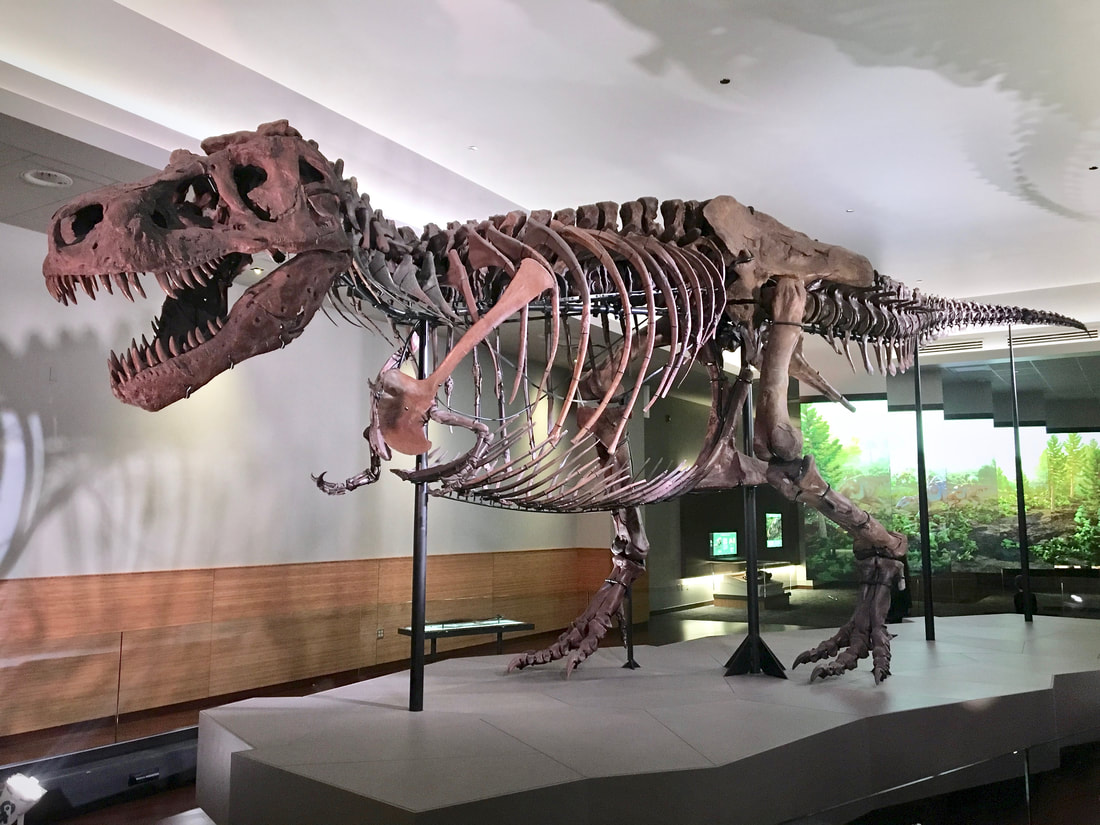
Sue the T. rex (FMNH PR 2081) is widely regarded as one of the most iconic and scientifically valuable Tyrannosaurus rex specimens ever discovered. Nicknamed after its discoverer, Susan Hendrickson, Sue stands out for its exceptional completeness, size, and public accessibility.
Discovery and Early History
Sue was discovered on August 12, 1990, in the Hell Creek Formation on a cattle ranch owned by Maurice Williams within the Cheyenne River Sioux reservation in South Dakota, USA. Susan Hendrickson, a paleontologist working with Peter Larson of the Black Hills Institute (BHI), spotted the first bones while exploring the badlands. The specimen dates to approximately 67 million years ago in the late Cretaceous period. Excavation revealed an extraordinarily well-preserved adult T. rex, but a multi-year legal battle over ownership ensued involving the landowner, the tribe, federal authorities (including an FBI raid), and BHI. The dispute was resolved in favor of public auction.

Auction and Acquisition
In October 1997, Sue was sold at Sotheby's in New York in a high-profile single-lot auction. The pre-sale buzz was intense due to its rarity, with the hammer falling after just nine minutes of bidding. The Field Museum of Natural History in Chicago won with a record-breaking bid of $8.36 million (including fees; equivalent to about $17 million today), backed by McDonald's Corporation, Walt Disney World Resort, and private donors. This was the highest price ever paid for a fossil at the time and sparked debates about commercializing scientifically important specimens. Replicas were created for Disney and McDonald's promotional use.
Size, Completeness, and Features
  • Length: Approximately 40–42 feet (12.3–12.8 meters) along the vertebral column.
  • Height: About 12–13 feet (3.66–3.96 meters) at the hips.
  • Completeness: Over 90% by bulk/volume (around 73% by individual bone count), with roughly 250 of the estimated ~380 bones in a full T. rex skeleton recovered—including rare elements like the furcula (wishbone), stapes (ear bone), and gastralia (belly ribs). This makes Sue the most complete adult T. rex known.
  • Notable traits: Massive skull with battle scars and pathologies (e.g., evidence of infections or injuries), robust build, and signs of a tough life (including healed fractures and possible infections in the jaw). Mass estimates for living Sue range from ~8–14 metric tons (with some studies placing it around 8–9 tons, potentially lighter than bulkier specimens like Scotty). Sue is among the largest T. rex individuals, though possibly slightly exceeded in mass by Scotty (RSM P2523.8).
Sue's skeleton has been updated over time to reflect advancing science, including added gastralia for a more accurate posture.
Current Status and Location
Sue remains a permanent centerpiece at the Field Museum of Natural History in Chicago, Illinois, where it has been on public display since May 2000 (with a major "private suite" renovation in 2018 featuring updated mounting, lighting shows highlighting key bones, and immersive Cretaceous environment displays). As of March 2026, Sue continues to draw millions of visitors and supports ongoing research. A traveling exhibit called SUE: The T. rex Experience (featuring a cast) tours museums, but the original fossil stays in Chicago.
​
Comparison to Stan the T. rex
  • Size: Sue is slightly longer (~40–42 ft vs. Stan's ~40 ft) and potentially heavier/more robust in some estimates, though Stan is more gracile (lighter build). Scotty may edge both in mass.
  • Completeness: Sue is superior at ~90% by bulk (Stan ~70%).
  • Auction: Stan sold for a much higher $31.8 million in 2020 (record until later sales like the $44.6 million Stegosaurus Apex in 2024), while Sue's $8.36 million held the record for decades.
  • Outcome: Sue went to a major public museum for research and education; Stan ended up in Abu Dhabi’s Natural History Museum (public display). Both highlight T. rex's appeal but also market trends.
Sue's combination of scientific value, dramatic backstory, and enduring museum presence cements its status as the "queen" of T. rex specimens.
Sue's Injuries and Pathologies
Sue (FMNH PR 2081), the exceptionally complete Tyrannosaurus rex specimen, displays a remarkable array of pathologies (abnormalities, injuries, and diseases) visible on her bones. These provide insights into a long, violent life (~28 years old at death, one of the oldest known T. rex), filled with trauma, recovery, infections, and chronic conditions. Many injuries show healing, indicating Sue's toughness and survival ability despite severe setbacks. Paleontologists interpret most as resulting from struggles with prey, intraspecific fights (e.g., bites from other T. rex), or secondary complications.
​
Here are the main documented pathologies:
  • Right Shoulder and Arm Injuries
    Damage to the scapula (shoulder blade) and humerus (upper arm bone), plus a torn tendon/ligament in the right arm (likely from a struggle with large prey like Triceratops). These healed, but left lasting effects on mobility or strength in that forelimb.
  • Healed Rib Fractures
    Multiple broken ribs (at least three, on both sides) that fully healed. Some sources note one rib healed in two separate pieces. These are often linked to traumatic blows, possibly from prey struggles or fights with other tyrannosaurs. The healing shows Sue survived and continued functioning for years afterward.
  • Left Fibula Deformity and Infection
    The left fibula (lower leg bone) is dramatically enlarged—twice the diameter of the right one—due to abnormal bone growth and infection (osteomyelitis, a bacterial bone infection). CT scans and studies confirm no clear fracture origin; instead, it's consistent with chronic infection, possibly from trauma allowing bacteria entry. This would have caused significant pain, swelling, and limping, yet Sue lived on.
  • Fused Tail Vertebrae (Caudal Vertebrae)
    Several distal tail vertebrae (e.g., c26 and c27) are fused together with extra bony lumps and overgrowth, diagnosed as osteomyelitis (bone infection) leading to inflammation, fusion, and arthritis-like changes. This is common in spinal columns under stress/infection and would have caused stiffness, chronic pain, and reduced tail flexibility in later life.
  • Mandibular (Jaw) Lesions/Holes
    The most enigmatic and debated: Multiple large, round holes (some golf-ball sized) on the back half of the left lower jaw (dentary and possibly surangular), with smooth, remodeled edges indicating long-term healing.
    • Early theories included bacterial infection (e.g., actinomycosis-like) or protozoan parasite (trichomoniasis/Trichomonas-like, common in birds today and proposed for some tyrannosaur jaws).
    • A 2009 study suggested trichomonosis caused starvation-level damage in some T. rex.
    • However, a 2022 study (Cretaceous Research) ruled out protozoan infection, showing no typical infection signs (e.g., nodules, extensive thickening). Instead, features match wound healing without infection—possibly bite marks, claw marks (e.g., from courtship/scratching behavior), or other trauma. Similar lesions appear in other T. rex, but distribution (only rear jaw, random pattern) doesn't fit typical bite rows. The cause remains mysterious, but likely traumatic rather than purely infectious.
  • Other Pathologies
    General signs of arthritis (e.g., bone spurs in backbone/tail from injury/degeneration), possible additional healed fractures, and overall wear consistent with age and a rough lifestyle. No clear evidence of fatal bite marks on the skull (unlike some specimens), but the jaw holes highlight potential intraspecific aggression or other interactions.
Sue's pathologies—especially the healed fractures and infections—demonstrate remarkable resilience: T. rex could recover from injuries that would debilitate many animals, likely aided by rapid healing and a robust physiology. These findings come from Field Museum studies, CT imaging, phylogenetic bracketing (comparing to birds/reptiles), and papers (e.g., Hamm et al. 2020 on osteomyelitis; Rothschild 2022 on jaw healing). They paint Sue not as frail in old age but as a battle-hardened survivor who endured repeated trauma.
Picture

3
​2023 Trinity
2023 SOLD for CHF 5.5M by Koller

A composite fossil skeleton of Tyrannosaurus Rex was sold for CHF 5.5M by Koller in April 18, 2023, lot 979.

This dinosaur named Trinity is made of three specimens of comparable size which were unearthed between 2008 and 2013 from the Hell Creek and Lance Creek formations in Montana and Wyoming.

Such an assembly typically requires seven to ten years of work according to the auction house. Trinity is announced as 
coming from a US private collection.

It is about 50 % original with 293 bones representing all body parts assembled in an overall size of 11.6 × 3.9 × 2.65 m. A traceability of the merging of the elements from the three originals is provided by the auction house. The skull length is 1.4 m from only the Lance Creek specimen.  The origin of most of the teeth is not identified in the skeleton map.

A Belgian art foundation has made an incredible purchase of a rare and impressive specimen - #Trinity the T-Rex.

It is the first #TRex skeleton sold on the European auction market and it will be publicly exhibited in Antwerp:

— Barnebys.co.uk (@Barnebysuk) May 10, 2023
2023

Triceratops
​Intro

Comparison: Triceratops vs. Stegosaurus
Triceratops (late Cretaceous, ~68–66 million years ago) and Stegosaurus (late Jurassic, ~155–145 million years ago) are two of the most iconic herbivorous dinosaurs, both armored quadrupeds from western North America, but they represent very different eras, ecosystems, and adaptations. They never coexisted (separated by ~80 million years), so no direct interactions occurred, though hypothetical matchups often appear in popular discussions.
Time Period and Habitat
  • Stegosaurus: Lived during the Late Jurassic (Kimmeridgian–Tithonian stages), primarily in the Morrison Formation (western U.S.: Colorado, Utah, Wyoming; also Portugal). The environment was a semi-arid to seasonally wet floodplain with rivers, forests of conifers, cycads, ferns, and horsetails—drier inland areas mixed with wetter floodplains. It shared this landscape with giant sauropods (e.g., Apatosaurus, Diplodocus), predators like Allosaurus and Ceratosaurus, and other ornithischians.
  • Triceratops: From the Late Cretaceous (Maastrichtian), in formations like Hell Creek and Lance (Montana, Dakotas, Wyoming). It inhabited subtropical coastal floodplains, swamps, and river deltas near the Western Interior Seaway, with abundant angiosperms (flowering plants), palms, magnolias, ferns, and conifers in wetter, more humid conditions. Contemporaries included hadrosaurs (Edmontosaurus), ankylosaurs, and apex predator Tyrannosaurus rex.
Triceratops favored swampier, coastal lowlands; Stegosaurus thrived in more varied, sometimes drier Jurassic floodplains.
Size and Build
  • Stegosaurus: Length ~6.5–9 m (21–30 ft, including tail), height ~4 m (13 ft) at the plates/shoulders, weight ~3.5–7 metric tons (up to ~5–5.8 tons for largest). Arched back, short forelimbs, longer hindlimbs, small head, stiffened high tail.
  • Triceratops: Length ~8–9 m (26–30 ft), height ~3–3.7 m (10–12 ft) at hips (lower center of gravity), weight ~6–12 metric tons (often 6–10 tons). Robust, low-slung body, massive skull with frill and horns.
Triceratops was generally heavier and more massively built (lower and stockier), while Stegosaurus was taller (due to plates) but lighter with a more arched, elongated posture.
Diet and Feeding
Both were herbivores, but strategies differed:
  • Stegosaurus: Low browser of ground-level vegetation (ferns, cycads, horsetails, low shrubs). Small, leaf-shaped teeth with horizontal wear; simple up-down jaw motion (orthal); horny beak; likely cheeks to hold food. May have swallowed gastroliths (stomach stones) for grinding. Focused on softer, low-growing plants in open or forested areas.
  • Triceratops: Selective browser/grazer of low-to-mid vegetation (ferns, palms, shrubs, possibly tougher angiosperms). Powerful shearing beak, dental batteries for grinding; could knock down taller plants with horns/bulk. Adapted to denser, wetter plant growth in floodplains.
Stegosaurus had a more limited, low-level diet; Triceratops processed a broader range with stronger jaws.
Behavior and Defenses
  • Stegosaurus: Likely solitary or in small groups; no large bonebeds known (rarer than some contemporaries). Defenses centered on passive armor: kite-shaped plates (possibly for display, thermoregulation, or intimidation) and tail spikes ("thagomizer") for swinging at predators. Plates may have been vascularized for heat control or visual signaling; spikes for active defense against theropods like Allosaurus (some fossils show healed bite marks).
  • Triceratops: More evidence for gregarious behavior (small groups, occasional bonebeds with multiples, juvenile clusters). Defenses: Three horns (brow horns up to 1 m) and large solid frill for charging, goring, or display; healed skull injuries from intra-specific fights (rival clashes) or possible predator encounters. Likely formed defensive circles or charged threats; more aggressive social interactions suggested.
Stegosaurus relied on tail weaponry and display armor; Triceratops emphasized head-based offense/defense and possible group protection.
Fossil Market Context
In recent auctions, Stegosaurus has surged: "Apex" (nearly complete specimen from Morrison Formation, Colorado; 27 ft long, 11 ft tall) sold for $44.6 million at Sotheby's in July 2024—setting the record for any dinosaur fossil—bought by billionaire Ken Griffin and loaned to the American Museum of Natural History. This exceeds Triceratops records (e.g., Big John ~$7.7 million in 2021) and even Stan the T. rex ($31.8 million), reflecting growing collector interest in plated dinosaurs.

Both were successful, heavily armored herbivores in their times, but Triceratops was larger/more massive with head-focused defenses in a predator-heavy world, while Stegosaurus emphasized unique back/tail armor in a sauropod-dominated Jurassic landscape. Their differences highlight how ornithischian herbivores evolved distinct survival strategies across ~80 million years.

2014 Big John
2021 SOLD for € 6.7M by Binoche et Giquello

In the popular imagery, the quadruped herbivore dinosaur Triceratops is the heavily armored giant rival of the tyrannosaurus, around 66 million years ago during the Late Cretaceous.

A triceratops skull excavated in Hell Creek in 2018 is 2.20 m long and 85 cm wide with its eponymous forehead horns about 75 cm long was sold for $ 500K 
by Sotheby's on April 28, 2021, lot 1.

On October 21, 2021, Binoche et Giquello sold for € 6.7M from a lower estimate of € 1.2M the fossil of Big John, considered as the largest known full triceratops, lot 1. It is illustrated in the pre sale release shared by Drouot.

The skeleton made of nearly 200 bones is 7.15 m long and 2.70 m high at the hip. The skull is 2.62 m long and the two major horns are 1.10 m long on a 30 cm base. The skeleton is 75 % complete for the skull and more than 60 % complete overall.

Big John had been wounded and probably killed in battle as evidenced with a severe tear below the neck, made from the horn of a similar beast. It has been discovered in 2014 in South Dakota and cleaned at the Zoic workshop in Trieste. Its displayed position ready to charge is inspired from the Wall Street Bull.

6 651 100 € !

C’est le résultat aux enchères de Big John, le plus grand tricératops découvert à ce jour, sous le marteau de Maître Giquello □□

□□ @BGiquello pic.twitter.com/YKlg9Vgszl

— Drouot (@Drouot) October 21, 2021

1993 Trey
2026 SOLD for $ 5.55M tbc by Joopiter

The final realized price for Trey the Triceratops skeleton at the Joopiter auction was $5.55 million (including premium). This figure comes from contemporary reporting on the March 2026 online auction (which closed on March 31). It fell within the pre-sale estimate of $4.5–5.5 million and marked Joopiter's first fossil sale, described as the highest price for a fossil in an online-only auction.
​
Trey, a sub-adult specimen discovered in 1993 and long displayed at the Wyoming Dinosaur Center, was the first long-term museum-exhibited Triceratops to reach the open market.
​
Detailed History of Trey the Triceratops
Trey is a well-preserved Triceratops skeleton from the late Cretaceous period (over 66 million years ago), discovered in 1993 near Lusk, Wyoming, in the Lance Formation. The find was made by renowned fossil hunter Lee Campbell and the late commercial paleontologist Allen Graffham, who was known for numerous significant discoveries. After excavation, the fossil was shipped to Germany for preparation, restoration, and mounting before being returned to the United States.
Trey debuted publicly at the grand opening of the Wyoming Dinosaur Center in Thermopolis, Wyoming, in 1995, where it served as a centerpiece exhibit and greeted visitors on long-term loan. It remained on display there for nearly three decades (until around 2023), viewed by over a million people and contributing to public education and some scientific interest in Triceratops specimens.
The skeleton measures over 17 feet (about 5.3 meters) long and more than 7 feet tall, representing a classic adult Triceratops with its iconic three horns and large frill. Specific completeness percentage isn't widely detailed in public sources, but it's described as exceptionally complete for a museum-exhibited specimen, especially given its long public display history. Trey is noted as one of the last privately owned dinosaurs discovered by Graffham to enter the market in recent decades.
In early 2026, after a private sale, Trey was relocated (including for viewings in Singapore) and announced for auction on Joopiter (the high-end collectibles platform founded by Pharrell Williams). The online auction ran from March 17–31, 2026, lot 1,with a pre-auction estimate of $4.5–5.5 million. It was promoted as a rare opportunity, being the only museum-shown Triceratops skeleton to hit auction at that time, amid surging dinosaur fossil prices driven by private collector interest.
Comparison with Big John
Big John, another famous Triceratops horridus specimen, provides an interesting contrast to Trey in terms of discovery, size, completeness, auction history, and market impact.
  • Discovery and History:
    • Big John was discovered in 2014 (with excavation completed by 2015) on private land in South Dakota (Hell Creek Formation equivalent age, ~66 million years old) by geologist Walter W. Stein of PaleoAdventures. It was nicknamed after the ranch owner.
    • Like Trey, it was commercially excavated and prepared (in Italy by Zoic workshop over 8–9 months). It didn't go to a museum long-term; Stein held it hoping for a museum buy before selling to a dealer for auction.
  • Size and Completeness:
    • Big John is recognized as the largest known Triceratops skeleton, at about 26 feet (8 meters) long and 9.8 feet (3 meters) high, with bones 5–10% larger than typical examples. Its skull alone measures 2.62 meters (over 8.5 feet) long, featuring battle scars (e.g., a healed horn injury possibly from rival combat).
    • Completeness: Over 60% of the full skeleton, with 75% of the skull (some sources note the cranium at ~70%). It includes well-preserved elements but varies in bone quality (some weathered).
    • Trey is smaller (17+ feet long, 7+ feet tall) and lacks the "world's largest" title, but its long museum display suggests strong overall presentation and possibly higher effective visibility/completeness for exhibition purposes (though exact bone count % isn't specified publicly).
  • Auction and Market:
    • Big John auctioned at Hôtel Drouot in Paris (via Binoche et Giquello) on October 21, 2021, with an estimate of €1.2–1.5 million ($1.4–1.7 million). It sold for €6.6 million (~$7.7 million including fees) to an anonymous U.S. buyer (later identified as Florida businessman Siddhartha Pagidipati), setting records as the most expensive Triceratops and a European fossil high at the time.
    • The linked X post from
      @Drouot
      (October 2021) celebrated this sale, highlighting Big John's massive size, impressive skull with a scar, and record-breaking price for a non-T. rex dinosaur.
    • Trey's 2026 Joopiter auction had a higher estimate ($4.5–5.5 million) but reflects the heated market post-Big John (and others like the $44.6 million Stegosaurus in 2024). Trey didn't break Big John's Triceratops record but underscored ongoing private collector demand.
Both highlight the booming private fossil market, where high prices often keep specimens from museums/research, sparking debates among paleontologists about access vs. commercial incentives. Trey's museum history gives it unique public legacy appeal, while Big John's sheer size and dramatic auction made it a landmark in the field.
Powered by Create your own unique website with customizable templates.
